How the electricity market actually works
If I have only one set of cables and pipes supplying my house, how can I have different "suppliers" of utilities? And how can they charge me different amounts?
Vladi
5/18/202611 min read
I always used to wonder, if I have only one set of cables and pipes supplying my house, how can I have different "suppliers" of utilities? How can I be choosing between Octopus, Ovo or British Gas - surely, I'm getting the same product via the same route? And by the same logic, how can different companies charge me different amounts for the same fungible good? My electricity doesn’t change, I don’t have better electricity because I pick one company over the other… so what’s that about?
Maybe some people already understand this, but I certainly didn't, and in finding the answer began my enduring interest in the UK energy market – because that stuff’s fascinating!
On the off chance that you are in the same boat, below is my attempt to explain how this works plainly, so you can understand it easily.
A quick disclaimer first – I acknowledge that the electricity market is extremely complicated, and the below is a simplification aimed at the general public, of which I am but a marginally more informed part. If I make any mistakes, please let me know and I will make sure to correct them.
So let’s begin.
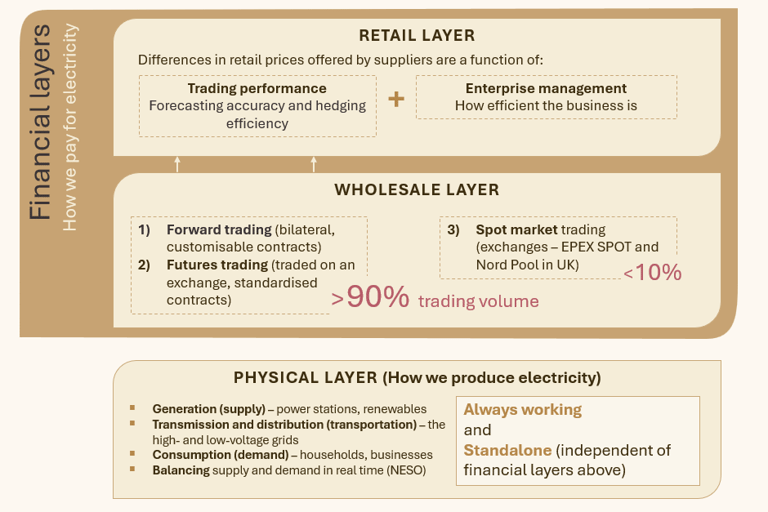
The way I conceptualise the electricity market is to picture it on three levels – a physical layer at the bottom, wrapped by two financial layers on top – the wholesale layer, which decides the price of electricity, and the retail layer, which decides the price charged to consumers.
Level 1 - The Physical layer
On the lowest level of the electricity market, we have the physical layer, where electricity gets generated, transported and consumed. In the UK, electricity is generated mainly by gas power stations, nuclear power stations, wind turbines and solar farms (for a full breakdown of the UK generation mix, click here and look for “Electricity generation mix by quarter and fuel source (GB)”). In most cases it is transported as soon as it is generated, via the electricity grid, to households and businesses throughout the country. Electricity is very difficult to store, and so most electricity does not get stored up, even when excesses of it are produced.
This inability to store electricity for long periods of time means that supply and demand on the grid must be balanced (i.e. equal) at any point of the day and night. This is the purpose of this entire physical infrastructure – to make sure enough electricity is generated in real time to enable you to turn on the TV or put the kettle on whenever you wish.
Most people don't realise the enormous complexity of this balancing act, which is happening in real time, all the time. Every 30 minutes, the system operator evaluates the balance of supply and demand and rectifies imbalances, whilst simultaneously monitoring the grid’s voltage and frequency, the weather, the timing of ad breaks on TV, and dealing with problems like unexpected outages and, well – the weather!
The physical layer is thus controlled by the system operator (in the UK that's NESO, the National Energy System Operator), whose job is to conduct this balancing act and make sure generation is always balanced on the grid.
The physical layer is standalone and completely unaffected by the financial layers above it. Whether or not your electricity supplier exists or goes bust tomorrow, and no matter what business decisions they make or what prices they charge you, this layer will continue to operate in the same way, day in and day out, because its ultimate function is to keep the lights on.
However, one thing to briefly note here is that since you use electricity throughout the day, you represent a unit of demand on the grid. And demand on the grid is reported to the system operator (NESO) by the people who know how much electricity people use – that is, utility companies who have access to this data for their customer pool. So, you as a unit of demand always belong to a single set of books, and those are the books of your electricity supplier. This does not affect how the physical layer works – if your supplier goes bust tomorrow, you will be transferred to another supplier, who will report your demand to NESO just the same. It only affects the subsequent layers, which deal with payments.
Level 2 - The Financial layer
So, this is how electricity is physically delivered to your home. Which to me raised another question – why are companies like British Gas and EDF called “suppliers”? If generators, like gas power stations and renewables, produce all the electricity, surely they are the actual suppliers of electricity, and utility companies are… what are they, actually?
The short answer is – they are almost pure financial traders.
While the physical layer is designed to always deliver, we still have to pay for it. Generators need to get paid to cover their costs and make profit, and the costs of the grid and balancing must be borne by someone. A market or other financial arrangement of some sort must exist above it. This is where the financial layer comes in, and its sole purpose is to pay for stuff.
2.1. The wholesale market
I spoke above about the fact that all customers in the country belong to their supplier’s books, and always only exist in a single book. Most people use one of the Big Six suppliers, which at the time of writing (May 2026) are Octopus, British Gas, E.ON Next, Ovo Energy, EDF Energy, and Scottish Power.
Suppliers know how many customers they have and are familiar with their usage patterns; they are therefore able to predict the demand for their customers in every half-hour interval of every day, month, season and year. (It really is every half-hour – look up the EFA day if you are interested).
They then use these predictions to “buy” the electricity on the wholesale market. Let me briefly explain those two concepts. Firstly, I have put the word “buy” in inverted commas because, although it is technically a purchase, it is not the physical, tangible purchase that intuitively comes to mind for the average person. Nothing changes hands – in fact, nothing can be weirder than trying to imagine handling a flow of electrons... You can’t identify your electrons from everyone else’s electrons. What happens here is more like an order placed with generators that says, “on this day, in this time window, please inject X megawatts into the grid and I will pay for it at X pounds per megawatt-hour”. The day and interval requirement will be based on those demand projections I mentioned.
And secondly – what is the wholesale market? The word “wholesale” means buying something in large quantities, as opposed to individual units, and typically refers to physical goods. As we’ve already discussed, we don't really buy electricity in a physical sense, but we pretend like we do for the purposes of paying for stuff – even though we are simply ordering or booking generation capacity at a power plant, and the power plant is injecting fungible current through the cables of a unified grid.
The wholesale market is the market where electricity is bought and sold. It contrasts with other markets in the power system, like the capacity market or the market for ancillary services, which do not involve the buying or selling of electricity (I plan to cover those in separate posts).
The wholesale market has two components – (1) the forward/futures market and (2) the spot market. I will take the liberty of digressing slightly from the orthodox approach by explaining the spot market first, as this is the simplest concept to understand, and the forward/futures market is an example of hedging, which deserves to be named as such.
A. Spot trading
The spot market is synonymous with trading electricity on an exchange (in the UK, this is typically EPEX SPOT or Nord Pool), very close to the delivery deadline. For example, I can technically procure all the electricity my customers will use on a Thursday by buying it on Wednesday or on Thursday itself, so long as I buy it a full hour before they are supposed to use it.
In technical terms, the spot market operates as a “blind auction in which the marginal generator sets the price”. If you did not understand this, don’t worry – neither did I at first, and I will explain this in detail in subsequent posts. The important thing to remember is that the price is calculated by the exchange according to supply and demand and, in the scenario I described, I will have no control over the price I pay – if it’s high and I need to procure electricity for the next day, I will have no choice but to pay it.
So, spot trading is characterized by the following:
Future-looking with a very short time horizon (day-ahead or intraday)
Happening on an exchange (EPEX SPOT/ Nord Pool)
Prices depend on supply and demand near delivery, so can be quite high
B. Forward markets (hedging)
I wanted to explain the spot market first because, technically, I can go and buy all the electricity my customers need on the spot market, on the day they need it or on the day before.
However, I would also go bankrupt in about 5 business days doing this.
Prices of electricity can fluctuate widely, depending on the conditions on the day, and most participants in the power market like certainty and stability – that includes both generators and utilities. They have a mutual incentive to agree prices ahead of time, to form a predictable view of their business and to hedge against future market fluctuations that can affect them adversely.
They do this by entering into hedging contracts for the purchase and sale of electricity (i.e. for ordering electricity) ahead of time, ranging from years to months in advance. There are two main types of hedging contracts – one fairly standardised, called a futures contract, and one very much customisable, called a forward contract. Apart from the degree of customisation, those contracts differ little – both agree the delivery volume, price and other conditions of sale ahead of time, locking in a price that gives both generators and utilities peace of mind and the ability to plan their finances.
Since futures contracts are standardised, they are traded on exchanges, and so are easy to find – for example, go to ICE’s website and search for “UK electricity”. You will see the two most commonly traded futures “UK Base Electricity Future (Gregorian)” and “UK Peak Electricity Future (Gregorian)”.
[Data source] The UK energy regulator Ofgem publishes regular statistics on the wholesale market, including average prices for forward contracts, and average day ahead prices here. You’re looking for those ones:
Electricity Prices: Forward Delivery Contracts – Weekly Average (GB)
Electricity Prices: Day Ahead Baseload Contracts – Monthly Average (GB)
Putting it together
Over 90% of all electricity is traded on forward/futures markets. Suppliers use those to buy the electricity they know their customers are going to need (baseload throughout the day, peak in morning/evening periods, etc.). The spot market is only used in the short term to make adjustments to purchasing in response to updated demand forecasts.
The reason I presented the order in reverse is to explain the need for hedging and contextualise the role of electricity suppliers – they are suppliers in name, but financial traders in substance. They don’t own the physical infrastructure that delivers electricity to your house – and so they don’t deliver electricity to your house. They make sure that the electricity you will use is ordered and paid for, and that both you and they are protected from market fluctuations by locking in prices in advance.
Three things are worth noting here as a side note:
Utility companies are often part of large groups who also own generators – for example, EDF has an arm (EDF Energy Nuclear Generation Limited) which owns all operational nuclear power stations in the UK. When they do, their generation arm, which owns the power plants, and their trading arm, which purchases electricity for customers, are generally separate. They tend to interact (e.g. the trading arm buys electricity from the generation arm), but that is usually not an exclusive relationship – purchasing and selling proceeds with other economic actors outside the group as well.
Hedging is ubiquitous in the economy as a whole – it happens across all sectors exposed to any kind of uncertainty. Banks hedge against interest rate fluctuations, foreign exchange rate fluctuations, commodity price fluctuations, and many other factors.
Finally worth noting is the existence of speculators who are similarly ubiquitous and who participate in buying and selling not to serve their customers (they don’t have physical customers), but purely to generate profit by betting on market movements. I am ignoring speculators for the purposes of this post, although they do affect the market.
2.2 What about your bills? The retail market
Now that we know how electricity is paid for, I return to the question I posed at the start of the post – why are different companies charging you different amounts for the same electricity?
Your electricity bill is made up of 5 broad components (look here for a brilliant visualisation by Ben James):
Wholesale costs – for simplicity, think of this as the average of all the prices your supplier locked in throughout the year on the wholesale market (forward and spot).
Network costs – paying for the transportation network and balancing
Subsidies – paying for various subsidies schemes, e.g. for renewable energy
Supplier costs – as the name suggests, the costs incurred by your supplier for running their business, and the margin they attach on top of it.
Tax and welfare schemes – VAT and schemes like the Warm Home Discount which amount to welfare projects outsourced to energy firms.
Of those components, numbers 2, 3 and 5 – network costs, subsidies and taxes – are a function of the system and usually allocated on consumption volume (i.e. the amount of electricity a company’s consumers use), and thus not controllable by your supplier.
It is the other two components – (a) the wholesale cost and (b) the supplier’s costs and margins – that chiefly account for the differences between supplier prices. Those components reflect two things – how good your supplier is in their role as a trader and how good they are at managing their business and controlling their costs.[1]
Specifically, the wholesale element reflects how good suppliers are at:
Forecasting demand (including smart meter rollout, which helps with forecasting accuracy)
Locking in good forward prices with generators, and
Hedging adequately (not leaving too much exposure to the spot market)
The costs and margins component is affected by things like:
How efficient your supplier’s operations are (IT systems cost, customer service, metering, etc.)
Their customer acquisition and retention costs (e.g. marketing, switching incentives, commissions paid to price comparison websites, etc.)
How good they are at managing bad debt and credit risk (the risk of non-payment)
The types of tariffs they offer (fixed tariffs leave risk with the supplier, especially if wholesale costs spike and they can’t raise tariffs to cover them. You might remember that fixed tariffs all but disappeared after the Russian invasion of Ukraine.)
How high their margins are (note that the UK market has a price cap set by Ofgem, so upward movement in margins is limited).
In short, the retail price is a function of how well suppliers manage the financial layer (forward + spot purchases) in their function as a trader, and how well they manage the efficiency of their own enterprise.
----------------------------------------------------------------------
[1] There is a small proportion of your bill (the Warm Home Discount) which acts as a wealth redistribution scheme, so you will pay more if your supplier has more customers eligible for this discount, but that does not have a material effect.
Summary and infographic to remember this by
The physical production, consumption and balancing of electricity happens all the time, independently of any financial contracts and prices. The process is overseen by NESO, the system operator, who balances electricity demand and supply in real time.
Several financial mechanisms exist above this physical infrastructure to enable us to pay for it. I have split them here into the wholesale market and the retail market.
Even though generators are the real suppliers of electricity, utility companies are referred to colloquially as electricity “suppliers”. Their real function is as a trader of electricity – they purchase enough electricity to cover the demand generated by their customers.
“Buying” electricity is another anti-intuitive concept, since electricity is a fungible and almost intangible good. So just think of it as the supplier (utility company) placing an order with a generator to inject electricity into the grid at certain times, rather than buying and delivering a physical good.
Suppliers (utilities) order most electricity in advance, using bilateral forward contracts with specific generators, or futures contracts on an exchange, to cover most of their customers’ baseload demand. They do this months or even years in advance, to hedge against volatile prices in the future.
Nearer the time of delivery (same day or the day before), utilities order more electricity on the spot market (another exchange) in response to updated forecasts about their customers’ behaviour.
Forward and futures markets and the spot market are the two components of the wholesale market for electricity, and when suppliers buy on those markets, they incur wholesale costs.
Wholesale costs reflect a blended, hedged, and smoothed version of your supplier’s purchasing decisions over the course of the year. They approximate an average of all the prices they locked in through forward contracts and spot buying. You would pay more if your supplier hedged poorly or forecasted inadequately – however, in reality, most suppliers are reasonably good at forecasting and hedging, which is why the differences in wholesale costs between suppliers are usually not enormous, except in crisis periods.
The way suppliers run their business also matters in determining the price you pay for your electricity. Here the differences are bigger. The better your supplier is at running an efficient enterprise, keeping their costs down and managing risk effectively, the lower your bill is likely to be. Thus, the retail price you’re charged reflects their abilities and competence as both a trader and an enterprise owner.
And this is how the electricity market works in a nutshell!