Marginal pricing and the role of gas in the electricity market
What does it mean to say that gas is the "marginal generator"? Or that gas sets the price of electricity 98% of the time? And is gas the ultimate culprit for your bills?
Vladi
6/2/202612 min read
In my first article on the electricity market (“How the electricity market actually works”), I explained the two components of the wholesale electricity market – the forward/futures market and the spot market. The former ensures that baseload electricity is ordered ahead of time, and the latter buys adjustments close to the delivery period (same-day or for the day ahead).
I also mentioned that the spot market operates as a “blind auction in which the marginal generator sets the price”, promising to explain what this means in a later article – and here it is! Welcome along, and if you haven’t had a chance to read my previous article, please do, as it’ll make this one much easier to understand.
The related concepts of marginal costs and marginal generation and pricing are extremely important to both the operation of the energy market and the public debate surrounding it. They are often mentioned in the media, yet very rarely explained and even more rarely placed in an appropriate context. This is why I am giving them their day in the sun here, with a dedicated deep dive and the fairest and most contextualised assessment I am currently capable of.
Why you should care about marginal pricing
I recognise that you are probably asking yourself – why should I care about this at all? It sounds so geeky and boring, and there are already people who understand this, why should I bother with it?
While I am clearly biased because I enjoy learning about the energy sector, I can offer you two compelling reasons why I believe everyone in the economy should care about this, including you:
First, a simple and practical reason – to be able to understand the news. As I mentioned, this subject actually appears a lot in the media, mostly as one of the following statements:
“Gas is the marginal generator”,
“The price of electricity is set by gas”, and
“The price of gas is set globally, so high energy prices are caused by high gas prices”
If you have ever, upon reading this, squinted suspiciously at the screen and wondered what the hell gas has to do with electricity, and what on earth a “marginal generator” is - all of these statements relate to the two concepts I will be explaining here, so don’t worry, I will make this very plain to understand.
The second reason you should care is so you can understand the public debate around the price of renewables. And that in turn is important because the UK is becoming increasingly reliant on renewables, so a discussion about their cost is a discussion about our bills (current and future).
In the cost-of-renewables debate, the following usually unfolds:
Proponents of the argument that renewables are cheap refer to the marginal price of renewables – the subject of this article.
Opponents of the argument that renewables are cheap refer to the subsidy price of renewables, which is a different price (and which I will explain in a separate post).
Consequently, this debate tends to happen on two different plains, which explains much of the misunderstanding and antagonism that surrounds it – people talking at cross-purposes can seldom agree.
Therefore, for you to really understand this debate, you need to understand both of these concepts (marginal cost and subsidies). That will enable you to pinpoint exactly which price a journalist or politician is talking about when they mention “the price” of electricity, and to make your own judgment about whether what they are saying is complete and accurate.
There is a third reason to care, which is more of a personal frustration, but here’s hoping you might share it. The power sector is so ridiculously overcomplicated that it is almost impossible for a normal person to understand. It has taken me hundreds of hours of reading articles, watching course content and sifting through obscure databases to build a somewhat coherent picture of the system and its various elements, costs, organisations and rules in my mind, and I continue to encounter confusing things all the time.
Yet the energy sector is the engine of the whole economy – no productive activity can take place without it. Which to me means it should be accessible to normal people to understand – otherwise, both the sector and the debate around it become the sole remit of journalists and politicians who, from what I have seen, don’t really understand it either. I often see bold claims being made in the media which omit 80% of the context affecting the claims, and very few people are knowledgeable enough to make an informed judgment about their fairness.
Here is attempting to tackle this by supplying the relevant context for you in a plain way, on the road to reclaiming the public debate.
So, let’s begin!
What is a blind auction?
Going back to our starting cipher - “the spot market operates as a blind auction in which the marginal generator sets the price”, I will first explain the concept of a blind auction.
An auction is a process by which generators submit into the spot market (a) the volume they are willing to generate, and (b) the price they require for that volume, for every half-hour bloc of the day (known as a “settlement period”). This is called “submitting an offer” to the market.
What makes an auction blind is that generators submit their offers without knowing the offers of other generators, so they have to offer based on their own economics (covering their own costs and margins) as opposed to reacting to other players’ actions or colluding with them. This is a commonly used mechanism to ensure fairness and competitiveness in an auction.
Similarly, consumers of electricity (usually utilities buying on behalf of their customers) submit bids to the auction to buy electricity, also stating their desired volume and price blindly for each settlement period.
The offers and bids are collected by the exchange (you will recall that the spot market operates on exchanges like Epex Spot and Nord Pool), which matches supply and demand for each settlement period and determines:
The equilibrium price and volume for supply and demand
The marginal generator required to meet that volume, and
The market clearing price (set by the marginal generator)
The marginal generator
The word “marginal” in the context of a “marginal generator” just means last. Specifically, it means the last generator needed to meet the required demand for the settlement period.
Last of what, though?
Last on something called the “merit order”. The merit order is a theoretical ranking of generators from cheapest to most expensive. Cheaper generators are dispatched first, expensive generators are dispatched last.
When determining whether a generator is cheap or expensive, we are referring to their “marginal cost”. This is the cost of generating one additional unit of electricity. Renewables have extremely low marginal costs, because the wind and the sun are free, so it costs nothing extra to keep a turbine spinning or a panel absorbing sunlight to produce electricity. Therefore, renewables usually come first in the merit order. Conventional generators, such as gas, nuclear, coal, diesel and oil, are farther along the merit order because they have inputs (fuel), and thus considerably higher costs of producing extra units of electricity – e.g. you need to keep buying and burning gas to generate extra energy from a gas power plant, or uranium to run a nuclear power plant.
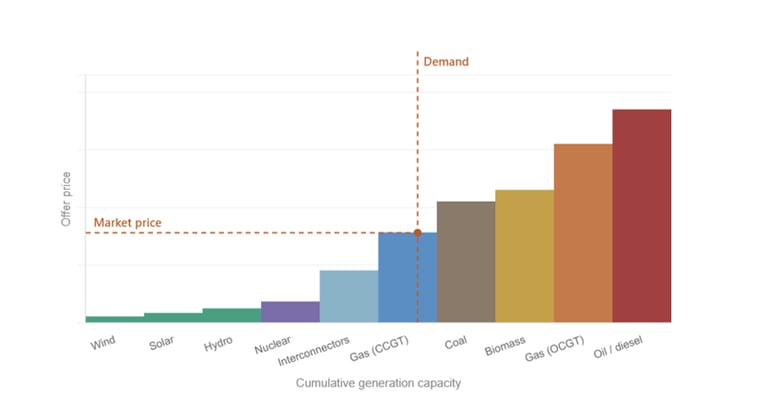
So, the merit order works on marginal cost. Most representations of the merit order you’ll see online are aggregated by generation type and look something like this:
Source: AI-generated example for illustrative purposes only – amounts are not tied to real data. Prices usually vary by season, fuel costs and market conditions. The order of different generators usually varies between markets depending on local conditions (e.g. coal may be cheaper than gas in some countries).
However, it is worth noting here that the merit order is an entirely theoretical concept – it is not a rule or regulation that demands compliance or paperwork. Graphs like the one above are often purely illustrative and don’t convey precise data.
The merit order is also intuitive to how markets operate naturally – cheaper goods get bought/ utilised faster in an efficient market. In practice, the merit order concept is incorporated into the logic of spot market exchanges. When the exchange receives the bids and offers for each settlement period, it plots a supply and demand curve in the background and determines the price and volume at which they intersect. It then accepts the cheapest offers from generators that cumulatively add up to this equilibrium volume and rejects more expensive generation which is not required. Demand is accepted based on how competitively it’s priced – very low offers are insufficient to secure generation and are effectively rejected. We will see an illustrative example of this below.
When accepting generators, the spot market algorithm will stop at the last generator needed to meet demand according to the merit order. That generator becomes known as the “marginal generator”.
“The marginal generator sets the price”
Now that we understand what the marginal generator is, what does it mean to say that it sets the price of electricity?
It means that all cheaper generators that precede it in the merit order get the same price as the marginal generator for their supply. In other words, if a wind farm offers £1 per MWh into the market, but the marginal generator is charging £80 per MWh for the same time bloc, the wind farm will also get £80 per MWh for generating in this period. The price set by the marginal generator is known as the “market clearing price” and the process is referred to as “marginal pricing”.
The logic of having a single clearing price for the whole market is two-fold:
The marginal generator must get the price they are asking for – otherwise they won’t be able to cover their costs, so they won’t switch on. Neither will anyone else demanding even higher prices, so there will be a gap in supply.
But then if someone is getting £80/MWh to generate, and all participants are generating the same fungible (undifferentiated) good, why would anyone else generate for a price of £1/MWh? They might as well not switch on or not build their generator in the first place. Conversely, if cheaper generators know they are going to get the market clearing price and their costs are effectively zero, they have an incentive to remain available and keep generating electricity, which the system operator ultimately wants to promote.
Since the word “marginal” is omnipresent in this article, let me summarise the three different terms I’ve used below:
Marginal cost - The cost of producing one extra unit of electricity (renewables – cheap; conventional generation – expensive)
Marginal generator - The last generator in the merit order needed to meet demand
Marginal pricing - The concept of the marginal generator setting the price for the whole market
Practical example of setting the market price
In case you like details as much as me, I also wanted to give you a practical example (albeit very simplified) of how an exchange might calculate the market clearing price.
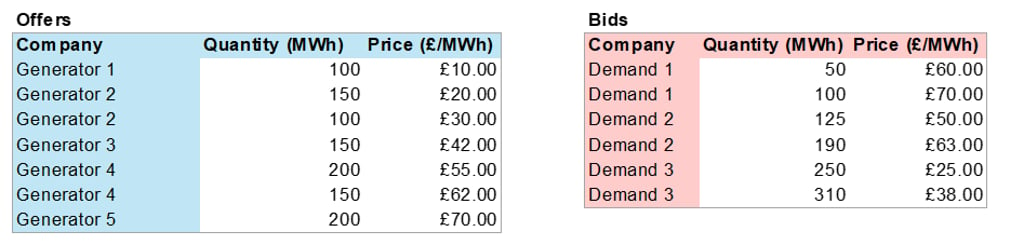
Consider the following fictitious set of offers and bids received for a settlement period (this data was adapted from a common practice question on energy markets). Our ask is to find the market clearing price based on these figures.
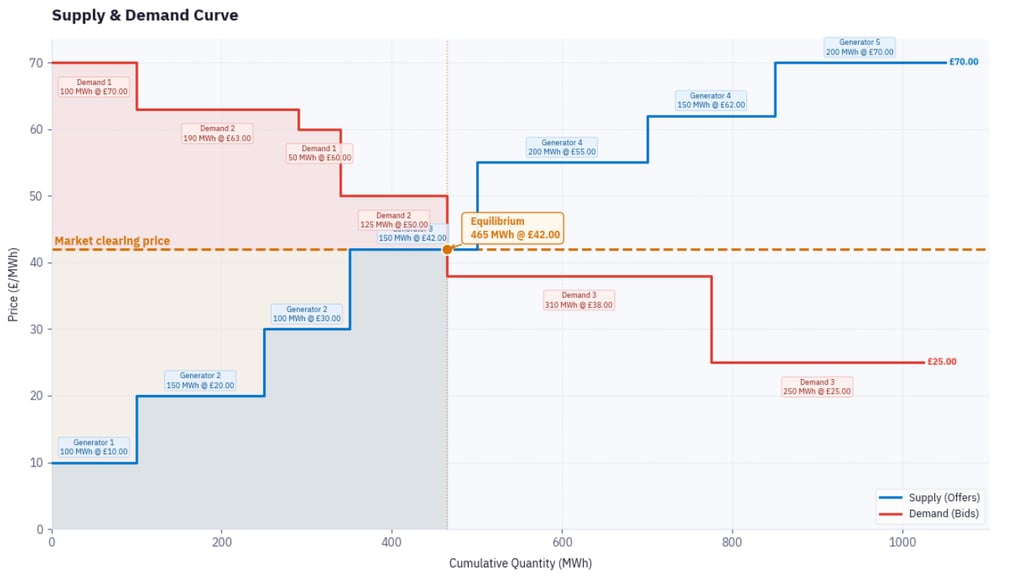
To find the market clearing price, we need to build a supply & demand graph in line with the merit order logic.
We start with Supply (generators’ offers in blue) and plot it in order of lowest to highest price per MWh, in line with the merit order.
Next, we plot demand in reverse order (demand increases as prices fall).
At the intersection point of the two curves, we find our marginal generator – in this case, Generator 3, the last generator needed to meet demand at 465 MWh.
The market clearing price, at the intersection of the two curves, is £42 per MWh. This price will then apply to all generators to the left of the equilibrium point, all of whom get paid £42 per MWh for their electricity – the price set by the marginal generator. The marginal pricing effect is represented by the yellow shaded area.
The Demand to the right of the intersection point does not get served, because those bids are lower than the clearing price (participants were not willing to pay enough to secure the electricity). Supply to the right of that point does not get despatched as it is not needed.
So, here is the final result:
So why the emphasis on gas?
Now that we understand how prices are set in the spot market, we can return to the subject of gas and how it affects electricity prices.
It is 100% correct to state that in Great Britain, gas (i.e. gas-fired power stations) sets the price of electricity almost all of the time, i.e. it is most often the marginal generator. It is true that extremely low wind prices get bumped up to the gas price.
What doesn’t usually get explained is why this is the case, and why we are yet unable to get rid of gas.
The first and most obvious reason why gas sets the price of electricity is that gas generation is needed. Based on everything we’ve covered so far, we know that the electricity market is set up to efficiently deploy the cheapest generators first, and only those generators that are needed to meet demand. By definition then, every generator deployed is needed, including gas.
So why does gas continue to be needed? Surely by now we can run our entire system on renewables?
Unfortunately, that remains a very difficult or even impossible task, and there are several reasons for this.
The number one reason why we are unable to fully rely on our current renewables is their intermittency. The two most common renewable sources used in Great Britain – wind and solar, are entirely intermittent. The wind doesn’t always blow and the sun doesn’t always shine, therefore every gust of wind and every passing cloud alter the amount of electricity fed into the grid by these generators. (The UK unfortunately has very limited hydro resources, because they require mountains and large river systems which we don’t have in abundance or in the right configuration.)
This intermittency means that a conventional generator is almost always needed to compensate for unavailable renewables supply (e.g. on still, cloudy days) or to compensate for temporary troughs in supply when weather conditions change. Most often, this compensating force is a gas generator, because gas generators can increase or decrease their output quickly and are relatively cleaner than other generators that can do the same (e.g. coal or diesel). Nuclear stations are unsuitable for regulating renewables because they need to be run at a constant rate and are expensive, slow and risky to constantly ramp up or down.
Secondly, electricity is very difficult to store. Even the most advanced batteries we have can only store a few minutes to a few hours’ worth of electricity – this is not enough to ensure steady supply when renewables are not generating, so we go back to gas as the compensating generator, for the reasons I listed above.
(Paradoxically, the best “hydro” solution the UK has (pumped hydro) actually functions like a battery, so that is probably the best storage solution we have available – still in limited amounts.)
The third reason that gas continues to be needed is transmission constraints on the grid. Most renewable power is generated in Scotland. Most electricity demand is in the south of England. Electricity generated in Scotland needs to be transmitted south, however this is limited by how much electricity can physically be transported on existing cables (the capacity on the cables) - and increasingly, this is falling far too short of what is needed. The UK needs to build an enormous amount more cables, pylons, substations and supporting infrastructure to be able to transport all electricity generated in Scotland south to where it’s needed.
What this means in practice is that, on windy days, wind turbines in Scotland are told to reduce or stop producing (they are “curtailed”), whilst generators closer to London are told to switch on or ramp up production to meet the demand in the south. So here too, gas is the compensating generator, this time compensating for inadequate transmission infrastructure and poor infrastructure planning (wind projects continue to be given the green light despite our current inability to transport their electricity efficiently).
Finally – and this is very poorly understood – the electricity grid needs to be maintained a certain way in order to remain stable and not collapse. It needs to stay at a certain frequency and certain voltage, and maintain a level of inertia that protects the grid from sudden volatility. Without going into details, the gist here is that these requirements of the grid are in practice much better served by conventional generators than by renewables. Therefore, if something threatens the stability of the grid, the response most likely to be deployed is a conventional generator – again, usually gas – to ensure that the grid doesn’t collapse and the lights don’t go off.
The considerations above point to the conclusion that it is inaccurate to position gas as a culprit in the renewables story – in each of the above scenarios, were gas not available to us, we would face the tough choice of “lights off” vs “deploy coal”.
Gas is needed because it is uniquely positioned to compensate for the shortcomings of both the technologies we happen to use, and our infrastructure planning lapses. Although nuclear is cheaper and cleaner than gas, it cannot perform those roles effectively, because it cannot quickly ramp up or down, or be shut off entirely (not to mention the fact that almost all of our nuclear stations are about to shut down by 2030).
In the absence of gas, for the reasons listed above, we would simply need another fuel to perform the same compensatory functions, and that one would be even dirtier than gas.
The other side of the cost debate
But let us suppose that all the issues I listed above are completely solved. All generation is now reliably provided by renewables. We don’t need anything else to run, for any reason. Will the market clearing price be low then? After all, the wind and the sun are free, and nothing else is needed on the merit order to override our cheap renewables, right?
Unfortunately, the answer is no – even in this scenario, the price would still not be particularly low. Because the companies who own and operate renewable assets are never in practice paid the marginal cost, and not just because they are paid the gas-dictated clearing price. They cannot ever be paid the marginal cost of generation for renewables - because they wouldn’t survive financially. This is the subject of my next article – “The cost of renewables – the CAPEX case” [In WIP]. Come along there and see what I mean!